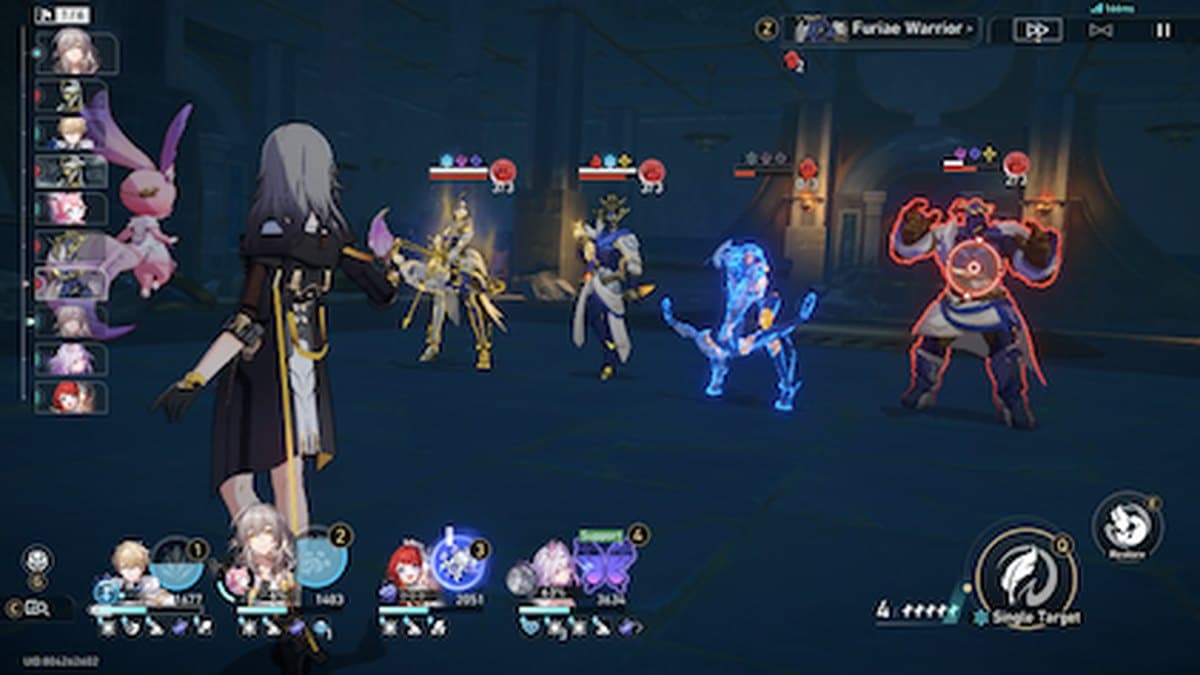
Break used to be the thing that happened to the enemy while your real DPS did the work. Then Break Effect teams learned to make the break itself the main event, and Super Break turned that into a full damage archetype that competes with any Crit carry in the game. If you have a Firefly, a Boothill, or a Rappa sitting in your roster and you are still building them like a normal DPS, this is the guide that fixes it.
First principles: toughness and the break window
Every elite and boss enemy has a toughness bar sitting above its health. Hit it with damage that matches one of its listed weaknesses and the bar drops. Drain it to zero and the enemy is Weakness Broken: its next action gets delayed on the action timeline, it takes a burst of Break DMG, and it suffers a type-specific effect.
Those effects are the whole reason Break exists as a strategy:
| Weakness type | Break effect on the target |
|---|---|
| Physical | Bleed (damage over time based on the target's max HP) |
| Fire | Burn (a flat damage-over-time tick) |
| Ice | Freeze (skips a turn, takes delayed damage) |
| Lightning | Shock (damage over time) |
| Wind | Wind Shear (stacking damage over time) |
| Quantum | Entanglement (delayed, and toughness taken scales the hit) |
| Imaginary | Imprisonment (slowed and action delayed) |
The instant of breaking deals a burst of Break DMG. Its base value is decided by the enemy's level and the weakness type, not by your ATK. What you control is the multiplier on top, and that multiplier is Break Effect.
What Break Effect actually multiplies
Break Effect (BE) is a percentage stat, and it does three jobs at once:
- It increases the Break DMG dealt at the moment of breaking.
- It increases the damage of the break DoTs (Bleed, Burn, Shock, Wind Shear) that follow.
- It feeds Super Break, which is where the real numbers live for modern Break DPS.
Because base Break DMG is fixed by the enemy, BE is close to a pure damage stat for a Break unit: every point of BE scales the whole package. A Break carry stacking BE is doing exactly what a Crit carry does when it stacks Crit DMG. It is the multiplier that carries the build.
Super Break: the mechanic that made Break a DPS role
Here is the leap. Normally, once an enemy is already broken, further toughness damage does nothing, because there is no toughness left to remove. Super Break changes that. When a unit or a team is granted the Super Break state (most commonly by the Harmony Trailblazer, and reinforced by certain characters and light cones), toughness-reducing hits landed on an already broken enemy convert into extra instances of damage, scaled by Break Effect.
That single rule rewrites the archetype. Instead of breaking an enemy once and moving on, a Super Break team wants to break the enemy fast and then keep pounding the empty toughness bar, because every follow-up hit now deals bonus damage. This is why Firefly, Boothill, and Rappa play the way they do: they are built to sustain toughness damage into a broken target, and BE turns each of those hits into a number.
The Harmony Trailblazer (the Fire "Harmony MC") is the enabler most players build around, because their kit grants the team Super Break based on the Trailblazer's own Break Effect. Stack BE on your Harmony Trailblazer and the whole Super Break team hits harder.
The breakpoints to aim for
Break units live and die by BE thresholds, and several of them are wired into character traces and enabler kits. You do not need exact numbers memorized, but you do need to know the shape:
- Support enablers (Ruan Mei, Harmony Trailblazer) often have a trace bonus that unlocks at a specific BE value. Ruan Mei, for example, gains an efficiency bonus once she crosses a BE threshold in the mid triple digits, so building her with a little BE is not optional.
- Break DPS want as much BE as the build can carry once they meet their kit's minimum. Boothill and Firefly both key breakpoints in their traces that hand out extra multipliers and effects when their BE (or, in Firefly's case, ATK-converted-to-BE) is high enough. Hit the threshold first, then keep climbing.
The general rule for a dedicated Break carry: get to the breakpoint your character's traces call for, keep SPD at a workable value, and then let everything else go to Break Effect.
Relics and light cones that build a Break team
You assemble Break stats from the same places as any build, just aimed differently.
- Relic sets: the four-piece Break-focused cavern set and the relic set that boosts Break DMG against higher-DEF or debuffed enemies are the staples for a Break carry. Enablers often run a Harmony or SPD-oriented set instead so they can act first and apply Super Break early.
- Planar ornaments: the Break-and-SPD planar set is the default backbone, because it hands out Break Effect and helps you hit SPD tuning at the same time. There is also a planar set built specifically around a BE threshold that rewards stacking BE past a breakpoint.
- Main stats: Break Effect on the Rope, SPD or ATK on the Boots depending on the unit, and effect stats where the kit asks for them. Break carries usually want a Break Effect Rope; enablers frequently want SPD.
- Light cones: several cones grant flat Break Effect or scale a bonus off it. Match the cone to whether the unit is the carry or the enabler.
Turning it into a team
A working Break or Super Break team is usually a Break DPS, the Harmony Trailblazer or Ruan Mei to grant Super Break and buff BE, a second support that either adds toughness damage or keeps the DoTs and debuffs flowing, and a sustain unit. The pattern is: break fast, keep the toughness bar drained, and let Break Effect scale every hit that lands after.
Once the core clicks, the relic substat priority guide tells you which rolls to chase, speed tuning keeps your enabler acting before the carry, and the paths explained guide puts Break units in context next to the rest of the roster. To see where these teams shine, take them into the endgame modes breakdown, check who is worth building on the best characters ranking, and start from the HSR hub with its tier list and current redeem codes.