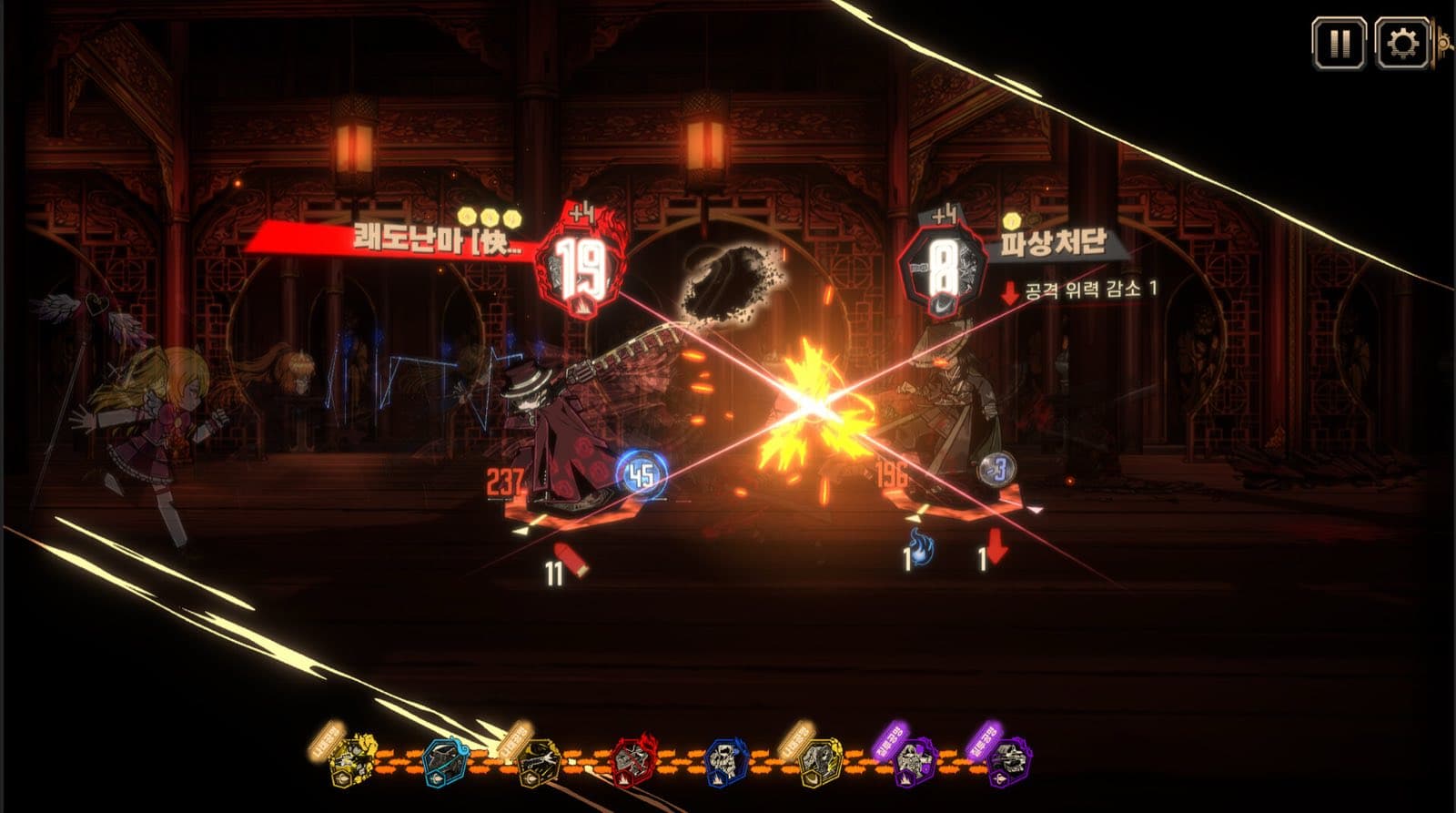

Here is the one thing that separates Path to Nowhere from most gacha games you have played: you do not tap to attack. You drag your Sinners onto a lane, decide who blocks what, and let the fight play out in real time. AISNO's tactical RPG is closer to a tower defense puzzle than an auto-battler, which means a smart new player with a weak roster routinely beats a careless one with a stacked account. So the first move is not "pull for the best unit." It is: learn the grid, then funnel your early resources into two or three Sinners instead of spreading them thin.
Everything below builds on that. You play as the Chief of the MBCC, arresting monstrous criminals called Sinners and deploying them as your squad. The city keeps breaking. You keep it standing.
The combat is a puzzle, not a clicker
Every battle is a small map with enemy spawn portals on one side and your Chief on the other. Enemies march toward you. If they reach the Chief and grind down your Sanity (SAN), you lose. SAN is the bar you are actually protecting, not any character's HP. (If you have read the game called a "DOOM" or "Mind" gauge elsewhere, that is loose shorthand; in the current version the fail condition is your Chief losing Sanity.)
You deploy up to six Sinners per fight. Placement is the whole game:
- Melee Sinners physically block a lane. A blocker holds a set number of enemies at once, so a single frontliner can stop a whole column, or get overrun if too many pile in. Watch the block count.
- Ranged Sinners have a clearly drawn attack range when you pick them up. Position them so that range covers the choke points enemies funnel through, and keep them behind your blockers where nothing can touch them.
- Break the Cores. Tougher enemies and bosses show bright orange diamonds by their health bar. Until you shatter those Cores, they barely take damage. Once broken, they stagger into a Break state and take far more. Certain Sinners exist specifically to pop Cores fast.
Skills come in two flavors. Passive skills tick automatically. Ultimate (active) skills are dragged, the same way you place a unit: pick up the skill, and the game shows its area and valid targets before you release to cast. That drag-to-aim is where fights are won, a well-timed stun on a packed lane or a heal dropped the instant your blocker dips low. You can also reposition Sinners mid-battle, so a fight is a running series of small decisions, not a single loadout you set and forget.
The classes, and what each is for
Six classes, and Path to Nowhere expects you to cover jobs, not collect one of everything. A team missing a frontline or a healer falls apart on any stage that lasts more than a few seconds.
| Class | Role | What it does on the grid |
|---|---|---|
| Endura | Frontline / tank | Blocks lanes and soaks damage so your backline never gets hit |
| Fury | Melee bruiser | Aggressive close-range DPS, backs up the tank and trades blows |
| Reticle | Ranged physical | Longest reach in the game; sits at the back and deletes single targets |
| Arcane | Magic / AoE | Explosive area damage, ideal against enemy hordes and grouped bosses |
| Catalyst | Support / healer | Healing, buffs, and debuffs; the glue that keeps a team standing |
| Umbra | Control / assassin | Stuns, slows, debuffs, and strong Core-breaking against bosses |
Damage also splits into physical and magic, and some enemies resist one or the other, so a roster that can output both ages better than a mono-damage team. For a full ranking of who is worth building inside each class, our Path to Nowhere tier list is the fast reference, and the deeper best Sinners breakdown pairs each pick with a team it fits into.
A workable first team is one Endura up front, a Reticle or Arcane doing the heavy lifting from the back, a Catalyst healing, and an Umbra to lock down anything dangerous. Fill the last two slots with whatever DPS you actually own.
The upgrade layers, in the order they matter
Path to Nowhere stacks several progression systems on top of each other. You do not touch most of them at level 1, and trying to feed all of them at once is the classic way to stall. Here is the hierarchy, weakest investment to heaviest.
- Level Up. The bread and butter. Spend DisCoins and Mania materials to raise a Sinner's level. Cheap, immediate, do it freely on your keepers.
- Promote (Phases). Each Phase raises the level cap and unlocks passives. Phase 1 lifts the cap from 20 to 40, Phase 2 from 40 to 70, Phase 3 from 70 to 90, using the Phase fluid materials. Phase 2 is the big one because it unlocks that Sinner's Crimebrand slots.
- Crimebrands (gear). Your equipment system, opened at Phase 2. Each Sinner gets three Crimebrand slots, and Crimebrands level up to 10 with Memory Fragments and DisCoins. Matching set pieces grant bonus effects, so a coordinated set beats three random strong pieces. This is a real chunk of a unit's power, but it comes later than beginners expect.
- Upgrade Skill. Raises the effectiveness of a Sinner's active and passive skills. Prioritize this on your main carry.
- Intensify Shackle. The deep, expensive layer: it consumes duplicate copies of the Sinner (or Sinner Marks) to push stats and unlock the strongest passives. This is the closest thing the game has to an "awakening" ceiling, and it is where you should be stingy. Confirm the exact current material costs in your version before you commit, and only pour dupes into a Sinner you have already decided is a long-term core.
The order to care about them early: Level and Promote your two or three keepers to Phase 2, get their Crimebrand sets going, and upgrade the carry's skills. Shackles come much later.
Where the currencies come from, and the stamina wall
- DisCoins are your standard currency, spent on almost every upgrade. You will always want more.
- Hypercubes are the premium currency (pulls, stamina refreshes, shop). Treat them as precious.
- Warrants are a pull currency you can also earn from shops, so recruiting is not purely paywalled.
- Stamina gates your farming. It refills roughly one point every six minutes, with a cap tied to your account level, and you can buy a chunk back with Hypercubes. Do not.
That last point matters. Your account level rises as you clear the main story (DisCity), and higher account level means a higher stamina cap and access to more modes. So in your first weeks, push the story rather than grinding side content. Story stages are also the cheapest, densest source of upgrade materials and account XP.
The modes you will actually see first
- Main Story (DisCity): your progression spine. Clearing chapters raises your level, unlocks systems, and drips the best early rewards. This is your priority.
- Interrogation: talk to captured Sinners through dialogue and evidence choices to raise their Compliance and unlock lore. Higher Compliance is not just flavor; it feeds into a Sinner's usefulness, and sessions hand out Hypercubes. Do these when they are available.
- Resource stages (The Rust and similar): rotating farming nodes for DisCoins, EXP materials, and Crimebrand mats. Spend stamina here on the specific material your current build needs, not randomly.
- Endgame and challenge modes: as your account matures, tougher recurring modes and boss challenges open up (the roster of these rotates with updates, so check the current mode list in-game rather than assuming a fixed name). They gate the best gear and currency, but they are not where a brand-new account should be sinking energy.
Live-service games patch fast, and Path to Nowhere is no exception, so before you plan around any single event mode, verify it is running in the current version.
Where your first month's resources should go
The short, blunt version:
- Reroll if you have the patience. Nox is a standout early carry and is obtainable through a login event rather than pure luck, which softens the reroll grind. Bai Yi and Langley are premium carries worth restarting for. Labyrinth is the rare S-tier at B rarity, so most accounts can get her, and she breaks shields nothing else can.
- Commit to two or three Sinners, not ten. Get them to Phase 2, start their Crimebrand sets, and upgrade the carry's skills. A focused trio clears content a scattered roster of level-20s cannot.
- Do not buy stamina with Hypercubes, and do not blow Hypercubes on shop bloat. Save them for pulls.
- Redeem the free stuff first. Grab every active gift code from our redeem codes page before you spend a single Hypercube; it is free currency and materials sitting on the table.
- Hold Shackle upgrades until you are certain a Sinner is a keeper. Dupes are too scarce to gamble.
That is the whole beginner arc: protect your Sanity by out-positioning the enemy, cover the six jobs with a small, well-built squad, feed your resources into a focused core, and let the story carry your account level upward. If you want a fuller sense of whether the game is worth the commitment before you go deep, our Path to Nowhere review lays out the highs and the grind honestly. Welcome to the MBCC, Chief.