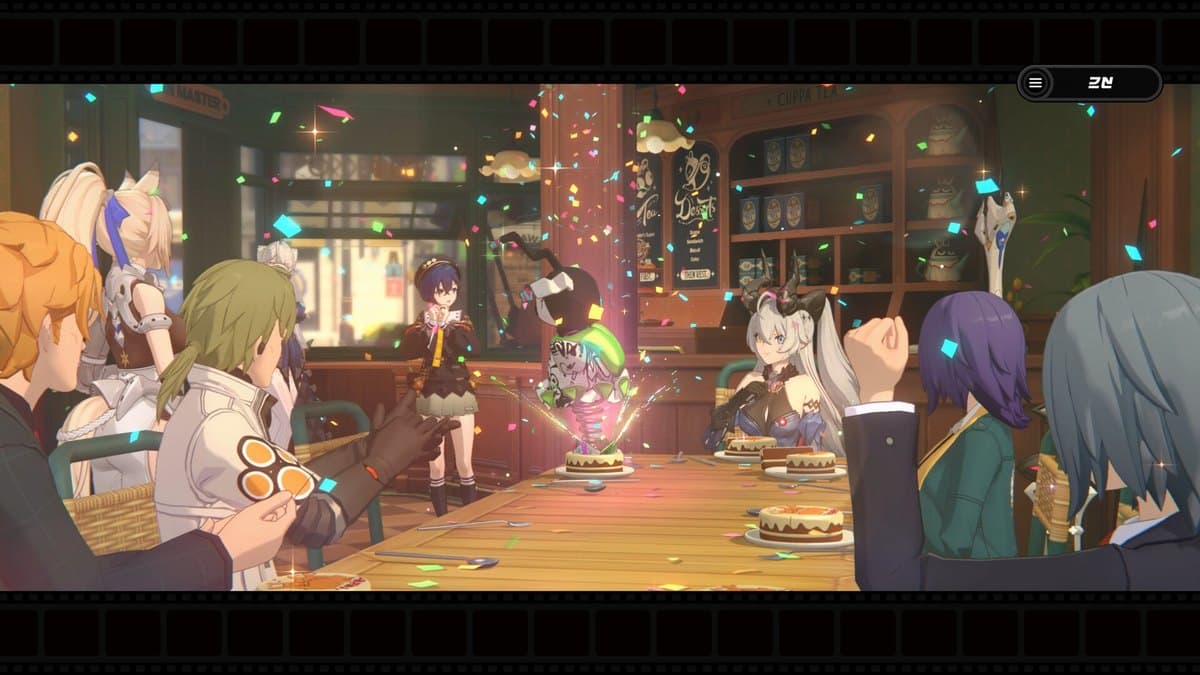
Someone in the call has not spoken in four minutes. Their mic is live, you can hear the ceiling fan in their room, and they are sitting on a hard pity Wish with the screen shared to nine people who have all stopped typing. The banner went up at reset. It is now, somehow, a spectator sport. When the animation finally goes gold instead of purple, the call does not cheer so much as detonate, and the person who was silent lets out a noise that is not quite a word.
This is a pull party, and if you have been in one you know it needs no explaining. If you have not, it is worth saying out loud how odd it is. Pulling is, mechanically, the loneliest thing in any of these games. One person, one account, one finger on a button that nobody else can press. The outcome is decided by a number generator that could not care less who is watching. And yet somewhere along the way we decided this private little transaction should have a live studio audience, a warm-up act, and a running commentary.
The screen share is the point
The mechanics did not ask for this. There is no co-op pull, no shared banner, no button that lets your friend take a turn. Genshin calls it a Wish, Honkai: Star Rail calls it a Warp, Zenless Zone Zero dresses it up as a Signal Search, Wuthering Waves goes with Convene, and in all four the game imagines exactly one player at exactly one menu. What the community did was route around that. We turned on screen share.
Watch what actually happens on banner day and the ritual is remarkably consistent across games that share none of the same players. The call fills up before the pulls start. Nobody wants to roll first. There is a stretch of pure stalling: people checking their currency count out loud, someone reciting the total they saved, someone else asking, for the fourth time, whether the featured character is worth it while everyone knows they already decided a week ago. The stalling is not indecision. It is the pull equivalent of a table settling before a poker hand. You do not spend that long saved-up currency in silence.
Then someone commits, and the whole tone changes. The person pulling narrates. The person watching holds their breath at the ten-pull animation like it is happening to them, because in the only way that matters it is.
Making them livestream the 50/50
The cruelest and most beloved version of this is the demand that a friend go live for their 50/50. You cannot fake a coin flip you have promised to broadcast. That is the entire appeal. When someone says they are about to hit their fifty-fifty, half the affection in the group takes the form of insisting they share the screen so the loss, if it comes, is witnessed and cannot be quietly swallowed.
There is something almost legal about it. A pull you do alone is a private matter. A pull you narrate to a call becomes part of a shared record. This connects to the whole reason the pity social contract holds together at all: the system only feels fair because we all agreed to believe in it out loud, together, and watching each other pull is how we keep renewing that belief. The friend livestreaming their Warp is not just being brave. They are submitting evidence.
And when they lose to a standard-banner five-star, the group chat does not stay calm. Losing the 50/50 to the character you already own three copies of is one of the purest injustices these games manufacture, and the reaction to it in a live call is a genuine communal event. Nobody planned to care this much about a stranger-adjacent friend pulling a duplicate they did not want. Everybody cares this much. The messages come in a wall. Somebody types NO in all caps. Somebody posts the crying reaction. The person who lost is, briefly, the most important person on the internet to eight people who will forget by tomorrow, which is exactly the right amount of importance.
The superstitions travel in packs
Pulling alone breeds private habits. Pulling together turns them into folklore that everybody suddenly shares. There is the person who insists on a specific pull order, single pulls until a certain count and then a ten. There is the account that has been declared lucky, and the friend who will log into it to pull on your behalf because their hands are, per group consensus, blessed. There is the ritual of having someone else tap the button for the last ten because yours have gone cold. None of this survives contact with statistics. All of it survives contact with a Friday night call.
What is funny is how fast these superstitions spread once they have an audience. A private habit is just a quirk. Say it in a call and someone else adopts it by the next banner, and now the group has a lucky account, a preferred pull order, and a designated proxy puller, none of which existed a month ago and all of which are now load-bearing tradition. Community superstition needs witnesses the way it needs nothing else. You cannot have a lucky friend if nobody watches them get lucky.
Secondhand, but not lesser
Here is the part that surprises people who have not felt it. The joy you get from someone else's pull is not a diluted version of your own. Sometimes it is stronger. Your own hard pity carries dread. A friend's carries only stakes you did not have to pay for, which turns out to be the ideal ratio. You get the animation, the gold, the payoff, and none of the currency guilt. Secondhand devastation works the same way in reverse: you can grieve a friend's lost 50/50 harder than they do, because you were spared the small self-protective numbness that kicks in when it is your own account bleeding out.
This is where the pull party stops being a joke and starts being the thing itself. A character reveal starts a private wanting. That wanting is what powers the new character honeymoon period, the frantic build week, the sudden certainty that this unit changes everything. But the pull for that character, the actual moment of getting or not getting them, is where the private wanting becomes public. You wanted them alone in your head for two weeks. You got them in front of nine people who screamed. The screaming is not decoration. It is the part you will remember when the character is old news and the support diff arguments have moved on to whoever is next.
Why the button needed company
So why does pulling alone feel incomplete to so many people? Because the game gives you a slot machine and no jackpot bell that anyone else can hear. A win with no witness is just a new entry in your roster. You built the audience yourselves to give the moment somewhere to land.
The pull party is the workaround for a design that forgot to make room for the best part. These games are full of features built for togetherness, co-op bosses and friend lists and shared events, and none of them produce the feeling that a screen-shared hard pity does at eleven at night with the mics hot. A single tap became the most communal thing on offer because we refused to let it be private. That is not a bug in how people play. That is the whole culture, sitting in a call, waiting for someone to stop stalling and pull.