Kill Fader. Build an Eternal Pyre and bank Embers. Sail north, kill adult Seals for pelts, and turn pelts plus Embers into Ember Charges, because those explosives are the only practical way to open a Gammeltroll. Blow up the petrified corpse, smelt the Petrified Tissue into Bloodgold, and that single ingot unlocks every weapon and armor set in the biome. Then it is Winding Tunnels for moulds, Mörkhalla for Malicious Blood, and Kall Fimbulbringer at the end.
That is the whole biome in a paragraph. The rest of this page is the detail you need to not waste a trip, and the numbers are the part most guides leave out.
Valheim 1.0 shipped on September 9, 2026, ending five years of Early Access and bringing PS5 and Switch 2 in alongside full crossplay. The Deep North is the sixth and final biome, and it is gated behind the Ashlands: no dead Fader, no progress.
The order that actually works
- Defeat Fader in the Ashlands. Hard gate, no way around it.
- Build an Eternal Pyre and stockpile Embers. You need them for charges, and you want a surplus before you sail.
- Craft the grappling hook off the Mistlands research tree. It costs nothing per throw and loses no durability, and the Deep North is vertical.
- Hunt the coastline first. Adult Seals drop Seal Pelts. Skip nothing else; the shore is the safest part of the biome.
- Craft Ember Charges at a Workbench: 1 Ember plus 2 Seal Pelts yields a stack of 10.
- Drop a Gammeltroll, then break the statue it leaves behind.
- Smelt Petrified Tissue with Coal in a Blast Furnace for Bloodgold ingots.
- Clear Winding Tunnels for Frostcores and the Mould: Intricate Key.
- Craft the Intricate Key and open the Gates of Mörkhalla.
- Trigger three Jotun invasions inside Mörkhalla for 3 Malicious Blood.
- Summon Kall Fimbulbringer with the Malicious Blood.
Steps 4 through 7 are the part worth internalising. Everything craftable in the Deep North runs through Bloodgold, and Bloodgold only comes out of a dead Gammeltroll, so the first one you kill is the real start of the biome.
Why Gammeltrolls need explosives, not weapons
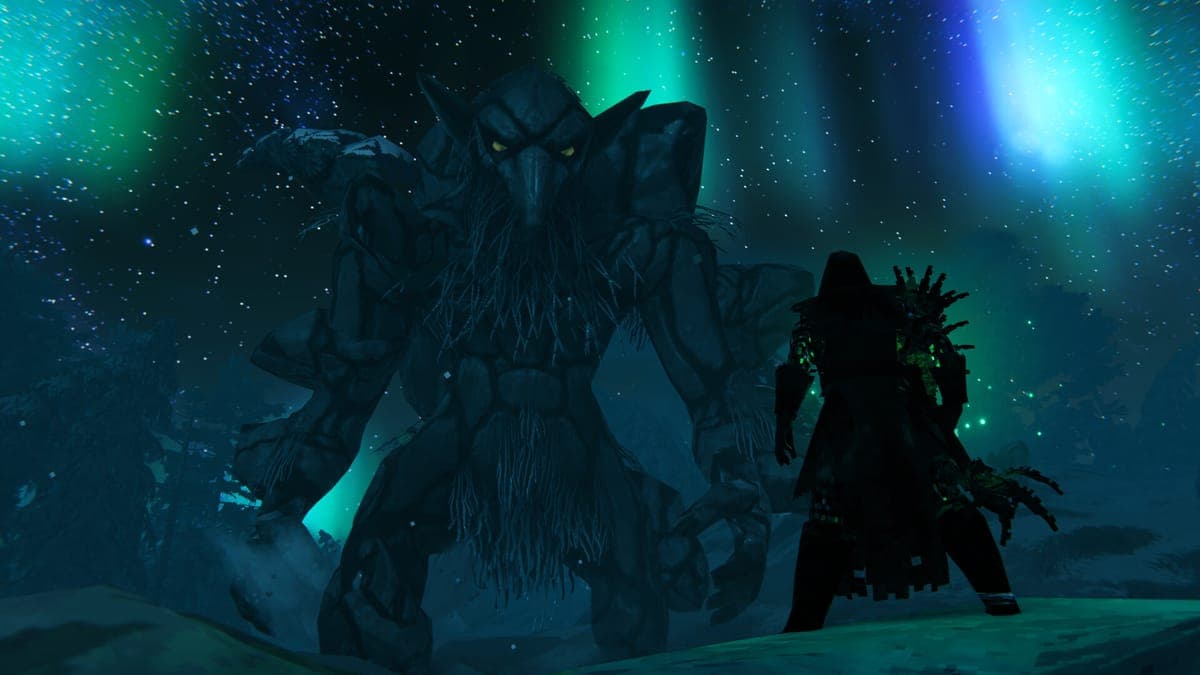
A Gammeltroll has 3,000 HP, the largest creature model in the game, and it resists essentially every physical damage type. Its head is a technical weakness, but the hit count to kill through it is impractical enough that it is not a strategy.
Here is the part that catches people: killing it is not the goal. When a Gammeltroll dies it petrifies into a statue, and that statue becomes terrain. You cannot mine it with a pickaxe. It is a resource node of 52 segments, and Ember Charges are what break it. Two charges, one at each ankle, collapses the body.
A fully broken statue yields roughly 86.6 Stone and 43.3 Petrified Tissue, because each segment rolls Stone at about 66.6% and Petrified Tissue at about 33.3%. Budget your charges around that: a stack of 10 is more than one troll needs, and pelts are cheap once you have a shore route.
Every Deep North creature, and what kills it
Almost the entire biome is weak to fire. The boss is the exception, which is why the endgame weapon choice flips at the last fight.
| Creature | HP | Weak to | Resists |
|---|---|---|---|
| Baby Seal | 200 | None | spirit |
| Elaking | 350 | fire | frost, spirit |
| Seal | 400 | fire | spirit |
| Moose | 1,000 | fire | blunt, slash, frost, spirit |
| Eyeless One | 1,400 | any physical | frost, spirit |
| Barka | 2,200 | fire | blunt, slash, pierce, frost, lightning, poison |
| Gammeltroll | 3,000 | Ember Charges | nearly everything |
| Kall Fimbulbringer | ~47,000 | blunt, slash | fire, pierce, frost, lightning |
Barka is the one to respect on the way in. It resists six damage types and only takes extra from fire, and its ranged ice attacks apply frostburn from outside melee range, so a cold-resistance food plus mead matters more than armor there.
The Eyeless One is the opposite case: 1,400 HP and vulnerable to any physical damage you bring. Earlier drafts of this guide called it the "Blind One" and described it as a boss-tier encounter in the Winding Tunnels. It is neither. It is a regular creature and it dies to whatever you are already holding.
Bloodgold, and the stations it feeds
Petrified Tissue plus Coal in a Blast Furnace gives Bloodgold ingots. From there the biome runs on four stations: the Black Forge, the Frigid Kiln, the Frost Foundry, and the Blast Furnace itself.
The gear loop is mould-driven rather than recipe-driven, which is new. You find a mould in the Winding Tunnels or in Mörkhalla, combine mould plus Bloodgold to produce a cast, then finish that cast at the Frost Foundry using Liquid Frost. No mould means no armor, however much Bloodgold you are sitting on.
The three armor sets
| Set | Role | Armor per piece | Set total | Notable |
|---|---|---|---|---|
| Protector | Heavy melee | 44 | 132 | Highest raw armor in the game. Breastplate resists frost. No set bonus. |
| Vanguard | Light, dodge-focused | 34 | 102 | Three-piece bonus: +10% health regen, +10% stamina regen, +10% pierce damage, -20% dodge stamina, -10% run stamina. Chestpiece resists frost. |
| Caller | Mage | 22 | 66 | +160% Eitr regen at three pieces (Headdress +40%, Robes +60%, Trousers +60%). Robes and Trousers both resist frost. |
The full Protector set runs about 60 Bloodgold ingots, so plan on more than one Gammeltroll.
Note what the frost-resistance column is doing: every set has at least one piece that covers frost, so no build is locked out of the biome. You do not need a specific set to survive the cold, you need the right piece of whichever set suits your build, plus Frost Resistance Mead for snowstorms. A Moose Hide Cape (12 armor, frost resist, -20% attack stamina, -20% run stamina) or the Cape of the Caller (12 armor, frost resist, +20% Eitr regen) covers the slot.
Weapons: Nord first, then pick an element
Nord weapons are the base tier, roughly 170 to 225 damage by type, 400 durability, costing 20 Bloodgold plus 10 Timberwood or an equivalent like Frozen Branch. They are not the end state; they are the blank you upgrade.
Two upgrade paths branch off a finished Nord weapon, each costing 20 Bloodgold plus one essence:
- Frostfire trades some physical damage for elemental, adding 12 fire (10 on the dagger) and 88 frost.
- Thunderblood keeps the physical damage intact and adds 45 lightning, with a 25% chance to apply a lightning effect on hit.
For Kall specifically, physical damage is what lands, so Thunderblood sledges and greatswords are the safer investment if you are only building one weapon. Frostfire looks better on paper and is worse in the fight you built it for.
Mörkhalla and the Intricate Key
The Gates of Mörkhalla stay locked until you craft the Intricate Key, and the mould for that key comes out of the Winding Tunnels. Inside, the structure is built around three Jotun invasions, each yielding one Malicious Blood. Three is what the summon needs, so Mörkhalla is not optional content you can skip toward the boss.
Kall Fimbulbringer, in three phases
Kall Fimbulbringer has the highest health pool of any boss in Valheim at roughly 47,000 HP across three phases: direct combat, a boss-spirit gauntlet, and the final confrontation. It resists fire, pierce, frost and lightning, so blunt or slash is the damage to bring. Thunderblood Sledge, Frostfire Sledge and Thunderblood Greatsword are the weapons that come up most.
The per-phase split that circulates in the community is roughly 10,000, then 7,000, then 30,000. Treat that distribution as community-datamined rather than confirmed by Iron Gate; the total is consistent across sources, the split is not. What it tells you regardless is where the fight actually is: the last phase is most of it, so bring more food and mead than the first two phases suggest you need.
What to bring from the Ashlands
- Carapace armor for melee or Eitr-weave for a mage opening load
- Cold resistance mead brewed before you sail, plus fire resistance left over from Ashlands cleanup
- Mistlands-tier food buffs for the health and stamina pool
- Embers, more than you think, from an Eternal Pyre
- The grappling hook, crafted before you leave
If you are still working toward Fader, the boss guide is the cleanest route through the earlier biomes, and the food guide covers keeping both bars topped during the run. The Deep North wiki entry carries the biome's drop and crafting data, and the Valheim tier list places the Nord and Frostfire weapons against everything that came before them.
Creature HP values, damage resistances and the Bloodgold yield figures above are community-documented from the 1.0 build rather than published by Iron Gate. They agree across independent Valheim wikis, and we have noted the one figure (the boss phase split) where they do not.