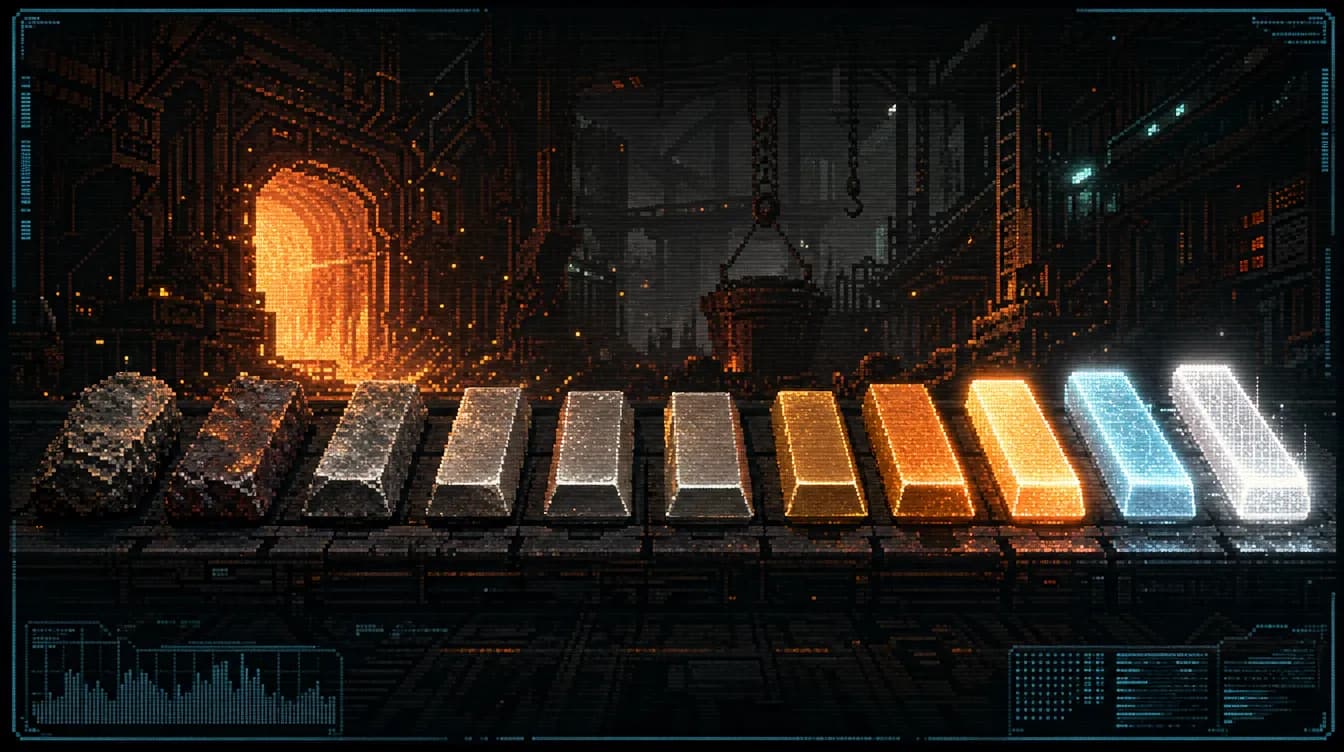
Crafting in idle games tends to fail one of two ways. Either it is a single linear ladder with one recipe per tier, or it is a flat soup of recipes with no progression spine.
Signal Decay splits the difference. The progression spine is one ladder. The recipes branch wide at every step.
10 tiers. 6 resource types. T1 through T8 feed equipment crafting. T9 and T10 are reserved for the endgame. Eight of the fifteen lifeskills consume from this backbone. This is the post that explains it.
The Tier Ladder
Ten tiers, named for the kind of material they represent. The names matter because the lore matters.
- T1: Scrap. Surface debris. The crash-site starter band.
- T2: Salvage. Pre-cataclysm recovered materials.
- T3: Refined. Smelted, purified, predictable.
- T4: Composite. Multi-material assemblies.
- T5: Resonant. Materials that hold a Signal charge.
- T6: Phased. Stable under signal interference.
- T7: Coherent. Materials that emit clean signal.
- T8: Anchored. Architects-era engineering, recoverable from deep ruins.
- T9: Singularity-grade. Endgame consumable and gem material.
- T10: Neutronium. Endgame masterwork material.
The first eight tiers are equipment. The last two are not. That split is deliberate.
Why T9 and T10 Are Not Equipment
Equipment crafting tops out at T8 because past that, the math gets ugly. T9 and T10 instead feed:
- Consumables. Top-tier food, potions, gem buffs.
- Gems. The 5 gem types times 8 tiers, minor through transcendent. T9 and T10 inputs feed the highest gem tiers.
- Masterworks. A small set of crafted items that compete with boss-drop legendaries. Not gear in the regular sense.
A T8 weapon is the ceiling. A T10 input upgrades what you put on top of that weapon, not the weapon itself. The progression curve flattens at T8 and pivots to lateral depth.
The Six Resource Types
Each tier exists across all six types. The types are the columns. The tiers are the rows.
- Metal. Mining output. Smelting, Forging input.
- Bio. BioHarvest output. Synthesis, Cooking, Pyrecraft input.
- Signal. Signal Tapping output. Signal Etching, Gem Resonance, Signal Runes input.
- Wood. Woodcutting output. Forging, Pyrecraft, Fabrication input.
- Aquatic. Fishing output. Cooking, Synthesis input.
- Synthetic. Compound output of multiple lower-tier materials. Synthesis, Fabrication input.
A T5 Metal is not the same thing as a T5 Signal. They are different materials at the same tier of the ladder. Recipes call for specific types at specific tiers.
The grid is 60 base materials. Each one is craftable, gatherable, or both.
Tool Tiers and Gathering
Gathering is gated by tool tier, not just skill level. Four tool types map to the four active gathering skills:
- Pickaxe. Mining.
- Hatchet. Woodcutting.
- Rod. Fishing.
- Harvester. BioHarvest.
Signal Tapping uses a different mechanic: signal range modifiers from equipped gear, not a tool tier.
Tool tiers run T1 through T8. A T3 Pickaxe on a T6 ore node hits a heavy success penalty. A T6 Pickaxe on a T3 node trivializes the gather. RuneScape players will recognize the math.
This means the crafting backbone feeds itself. You forge a T5 Pickaxe at Forging level X, you go gather T5 ores, you smelt T5 bars, you forge T6 gear, the loop steps up one rung.
Recipe Branching
Inside each tier, the recipe graph branches.
A T5 melee weapon needs a T5 Metal blade, a T4 or T5 Wood haft, and a T5 Signal binding. Three inputs, each from a different gathering skill, each potentially upgraded a tier for a stat bonus.
A T5 staff needs a T5 Wood shaft, a T5 Signal core, a T5 Synthetic housing. Different gathering profile. Different end weapon family.
A T5 ranged weapon, a T5 armor piece, and a T5 jewelry base each pull from different combinations of the six resource types. The six gathering skills feed the eight crafting skills through this matrix.
Per tier, there are dozens of viable recipes. The progression spine is the tier. The width inside each tier is what makes the climb interesting.
Gem Resonance, the Other Backbone
Sitting on top of the equipment crafting line is the jewelry economy.
- 5 gem types times 8 tiers. Forty base gems.
- Gem Resonance crafts gems into permanent jewelry. 80 craftable rings and amulets.
- Alternative path: consume gems for temporary buffs.
Gems are dropped, mined through Mining and Signal Tapping, and crafted from compound inputs. The high-tier gems pull from T9 inputs, which is the only equipment-adjacent use case for T9 material.
A late-game character has T8 weapons and T8 armor with T8 gems forged into T8 jewelry, eating T9 consumables, holding a T10 masterwork in the offhand slot. That is the endgame loadout shape.
Crafting Skills and the Tier Climb
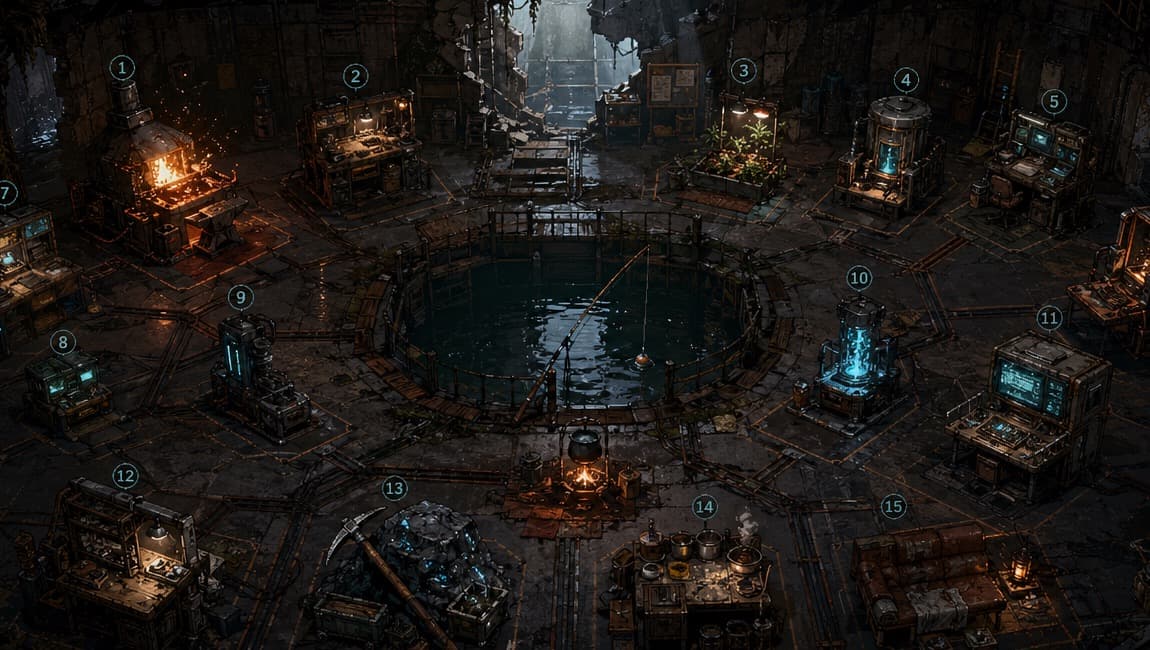
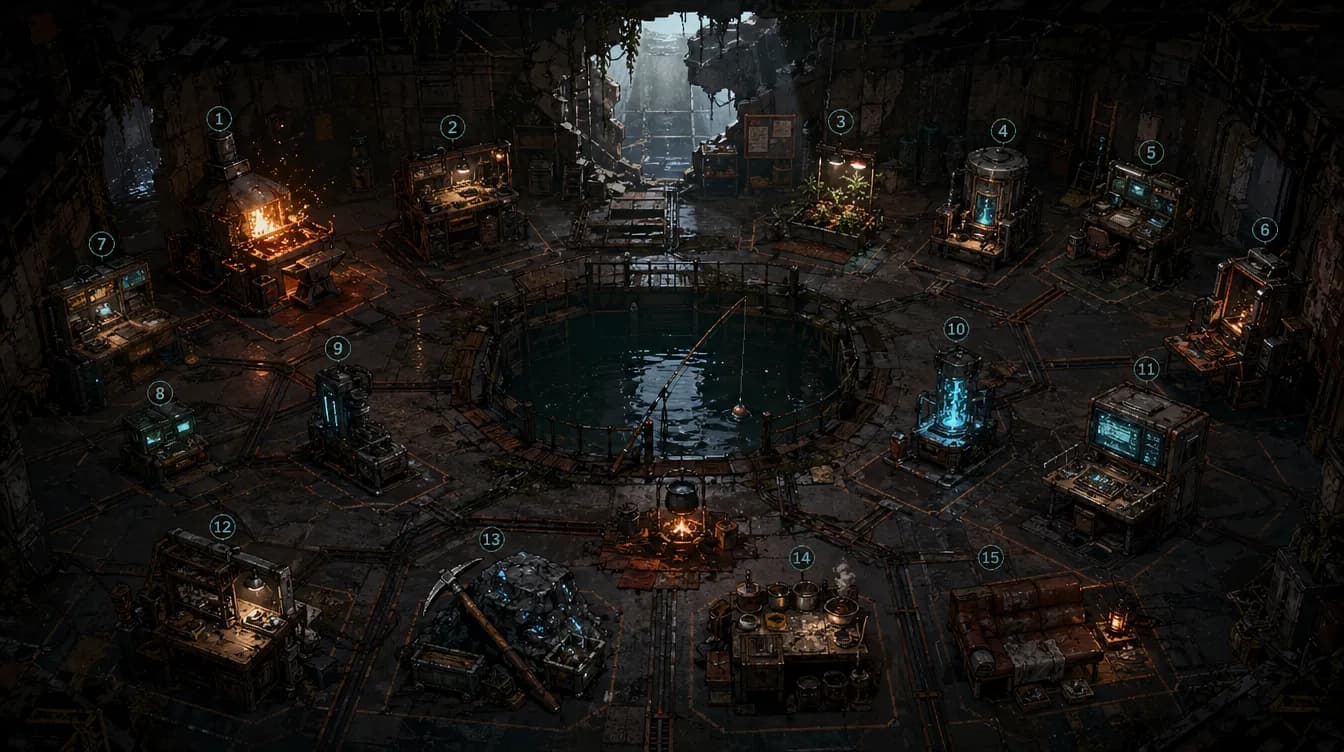
Each of the eight crafting skills levels through the ten-tier ladder.
- Smelting. Ores to bars. Tier-locked recipes from T1 to T10.
- Forging. Bars and components to weapons and armor. T1 to T8.
- Synthesis. Multi-input compounds. Spans the full ladder.
- Signal Etching. Inscribing onto gear and consumables. T1 to T10.
- Gem Resonance. Permanent jewelry through gem forging. T1 to T8.
- Pyrecraft. Heat-driven crafting. Glasswork, ceramics, signal-stable casings. T1 to T10.
- Cooking. Food and potions. T1 to T10.
- Fabrication. High-tier assembly. Tools, equipment frames, structural components. T1 to T10.
Eight skills, each a 99-level grind, all moving up the same ten-rung ladder. Time-to-99 in any one of them lands around 346 hours.
Loot Philosophy Sits Outside the Tiers
Worth saying explicitly: legendaries do not sit on the tier ladder.
Legendaries never drop from regular monsters or shops. Three sources only:
- Boss kills at 5%.
- Nat-20 rolls on crates.
- Tower milestone rewards.
A legendary T6 weapon might outperform a crafted T8 in specific matchups because of its passive proc. The crafting backbone is the predictable progression. Legendaries are the lateral reward layer on top.
Why Ten
Ten tiers is the smallest number that supports four progression beats:
- Early game (T1 to T3).
- Mid game (T4 to T6).
- Late game (T7 to T8).
- Endgame (T9 to T10).
Five tiers compresses too hard. Twenty tiers turns each rung into busywork. Ten tiers, six types, eight crafting skills: the matrix is wide enough to feel deep, narrow enough to ship.