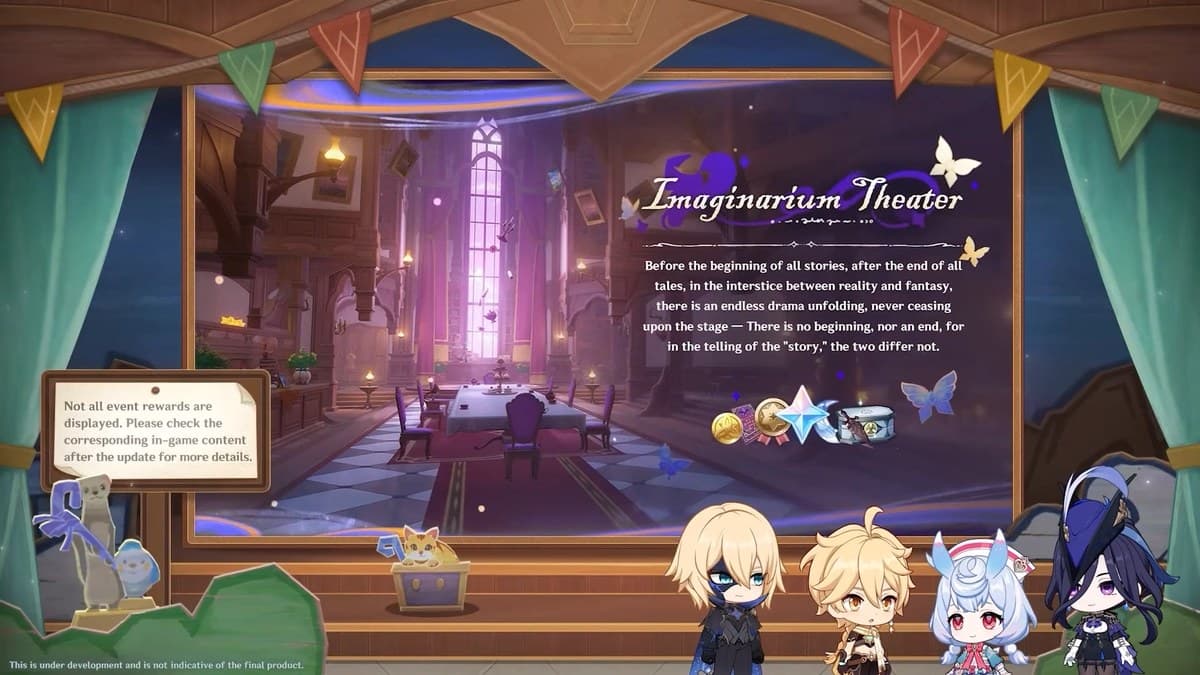
Spiral Abyss asks you to build two great teams. Imaginarium Theater asks a completely different question: how deep is your bench? It is Genshin's endgame for roster breadth, the mode that finally rewards those half-built characters gathering dust, and it quietly punishes anyone who has poured everything into a single hyper-invested comp. If you have opened it, stared at the "you do not meet the requirements" wall, and closed it again, this guide is for you.
What Imaginarium Theater actually is
Imaginarium Theater is a rotating combat challenge that resets on a schedule (currently monthly) and drops a fresh set of rules each season. You clear a run of consecutive stages using a large squad drawn from a limited pool of eligible characters, picking up buffs between stages and trying to finish every act with full stars for the maximum Primogem payout.
The twist that defines the whole mode is the character pool. Each season restricts you to a few featured elements, and you have to field enough owned, leveled characters of those elements to even start the harder tiers. You cannot rerun the same four-person team through the whole thing. You are assembling a rotating cast, and characters get "used up" as you deploy them across acts.
The requirements wall, explained
This is where most players get stuck, so read this part carefully.
To attempt Imaginarium Theater's meaningful difficulties, you need:
- A minimum number of eligible characters at a required level. The mode gates entry behind owning several built characters (historically in the range of eight, adjusted over patches) at a high level threshold, drawn from the season's featured elements plus a set of always-eligible "opening" characters.
- Coverage across the season's featured elements, because you will be deploying multiple teams and cannot lean on one element the whole way.
The practical takeaway: breadth beats depth here. A player with fifteen characters at level 80 and decent artifacts will clear this comfortably even without meta signature weapons, while a whale with three god-tier carries and nothing else will hit the wall. If you are building toward Theater, spread your resin: level a wide bench of characters to the required threshold across all elements rather than perfecting one team. Our best characters guide flags which units are worth investing in across each element.
Because the featured elements rotate, some months your roster lines up perfectly and some months you are scraping to meet the count. That is intentional. It is the reason to keep building characters you would otherwise ignore.
Trial characters and borrowed support
To soften the roster wall, Theater lends a hand:
- Each season offers a set of trial characters you can slot in for free, usually tuned to that season's elements. Use them; they count toward your playable squad and are often pre-built to a usable level.
- You can also bring in support cast characters connected to the season, extending your bench beyond what you own.
Do not skip these. A well-chosen trial unit can be the exact piece that lets you fill a fourth team and push a difficulty higher.
Fantasia Flowers and Blessings: the roguelike layer
Inside a run, Theater borrows from the roguelike playbook. You collect Fantasia Flowers, a currency spent to unlock more character slots and buffs, and between acts you choose Blessings (called Wondrous Boons and similar seasonal effects) that stack across the run.
How to pick them:
- Prioritize Blessings that scale with how you are actually winning. If your damage comes from a specific reaction or element that season, the buff feeding it beats a generic stat bump.
- Spend Fantasia Flowers on more character slots early when you are worried about meeting deployment requirements, and on offensive buffs once your bench is secure.
- Some Blessings reward specific playstyles (on-field carries, reaction teams, shielded uptime). Lean into the ones your roster supports rather than the ones that sound strongest in a vacuum.
The buffs snowball, so a run that starts shaky often ends with your teams doing several times their base damage. That is the mode working as intended, and it is why an under-invested account can still full-clear with smart Blessing choices.
Difficulty tiers and stars
Theater layers difficulty so both new and veteran accounts get something:
| Tier | Who it is for | What it wants |
|---|---|---|
| Easy / Normal | Newer accounts meeting the minimum roster | A functional bench and basic teams |
| Hard | The default full-reward target for most players | A broad, leveled roster and decent artifacts |
| Visionary / higher tiers | Veterans chasing the ceiling | Deep investment across many characters and clean play |
You earn stars for clearing acts and hitting bonus objectives, and stars are what convert into rewards. The goal for most players is simple: clear up through Hard with full stars for the bulk of the Primogems, then push higher tiers only if your roster and time allow. The final challenge tiers are prestige content, not required for the main payout.
Rewards and why it is worth the effort
Theater's headline reward is Primogems, paid out by the stars you earn each season, on top of talent and character materials and seasonal cosmetics like namecards. Combined with Spiral Abyss, it roughly doubles the endgame Primogem income for players who clear both, which is a meaningful chunk of pulls over a patch cycle. Stack that on your codes and events and it adds up to real banner funding.
The less obvious reward is what building for it does to your account. Chasing the roster requirement forces you to level characters you would never touch for Abyss, and a broad, flexible bench makes every future team and every new banner easier to slot in. Theater is, in a sense, the game nudging you to become a better-rounded player.
Clear checklist
- Meet the roster requirement by leveling a wide bench across the season's featured elements, not one perfect team.
- Slot the trial and support characters to extend your deployable squad.
- Spend Fantasia Flowers on character slots first, then buffs.
- Choose Blessings that amplify your actual win condition.
- Target full stars through Hard for the main Primogems; push higher only if you can.
Where to go next
Theater and Abyss are two halves of the same endgame, and they reward opposite things: depth for one, breadth for the other. Once your bench is built, take your best two teams into the Spiral Abyss Floor 12 guide, then tighten your comps with the team building guide and squeeze more out of your gear with the artifact guide. If you are weighing whether Genshin is still worth the time investment in 2026, the full review makes the case, and the gacha hub puts it in context with the rest of the genre.